
Managing Reality Wisely: A Practical Model for Responding to Life
We often use the word “reality” as though it were something simple and obvious. Yet, much of what we experience as reality is shaped by memory, imagination, emotion, interpretation, and the stories our minds continuously create.
This raises two fundamental questions:
What is actually happening?
And then: What can I do about it?
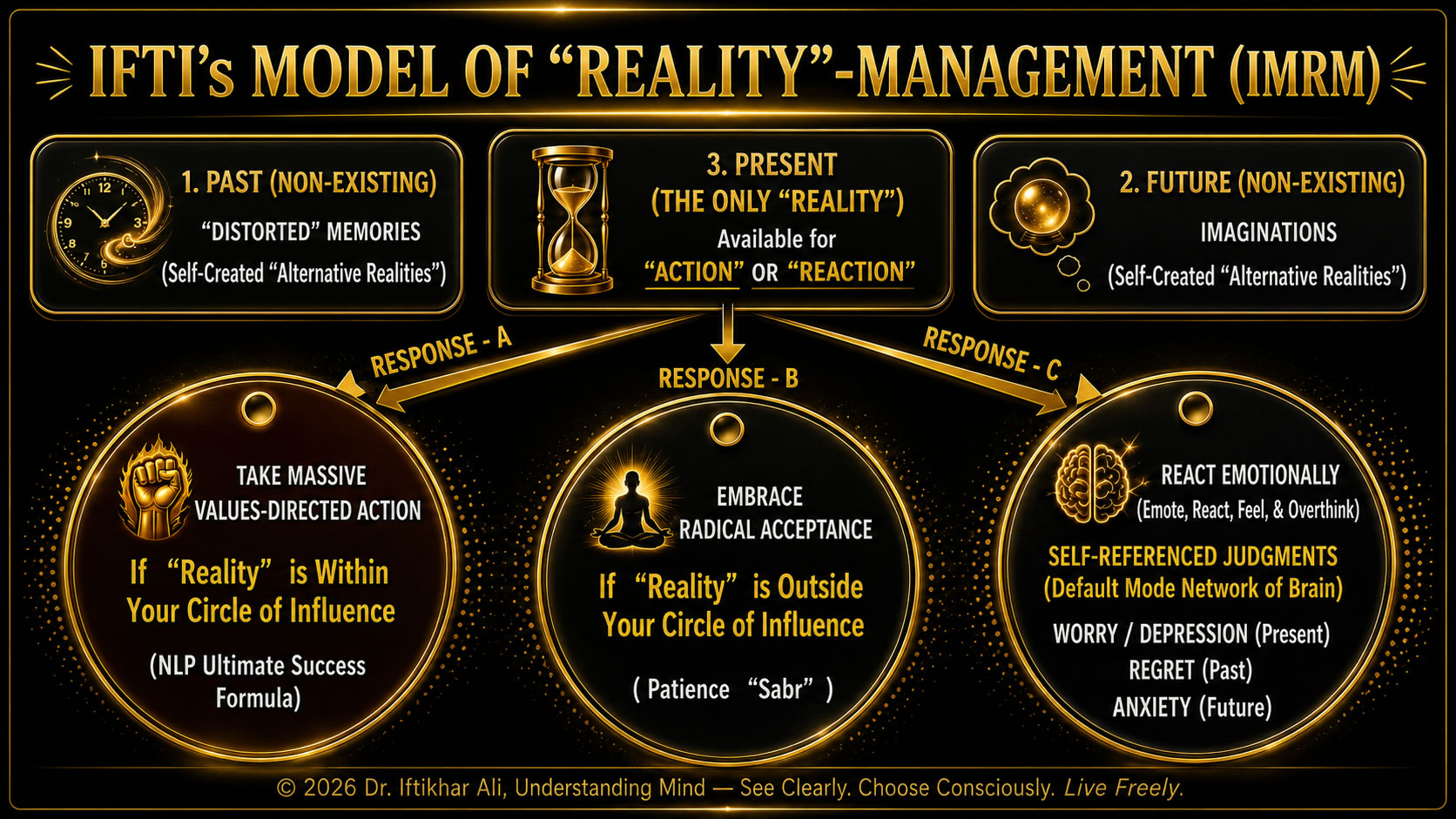
These two questions lie at the heart of Ifti’s Model of Reality-Management (IMRM), presented in Understanding Mind. The model offers a simple but powerful way of understanding our relationship with reality—and, more importantly, how we can respond to it wisely.
The Present Is the Only Reality Available to Us
The IMRM begins with a deceptively simple distinction: the past and the future do not exist in the present.
The past exists for us as memory. But memory is not a perfect recording of what happened; it is a reconstructed representation, filtered and influenced by our experiences and emotions.
The future, meanwhile, exists only as imagination—our mind’s simulation of what might happen. Such imagination can be extremely useful for planning and preparation, but it can also generate anxiety when we emotionally experience imagined events as though they were already happening.
The present, therefore, is the only temporal position in which reality actually exists—and the only moment in which we can act, change something, address a problem, or consciously accept what cannot be changed.
This distinction has an important practical consequence:
We should not spend the resources of the present fighting realities that exist only in the past or future.
Three Possible Responses
Once we recognize what is actually present, the IMRM proposes three broad responses.
Response A — Take Massive Values-Directed Action
When the situation lies within our Circle of Influence, the appropriate response is action.
Not merely wishing. Not endlessly thinking. Not waiting until we “feel ready.”
We identify what we want, take action, observe the result, and adjust our approach. This reflects the NLP Ultimate Success Formula incorporated into the model.
The key is values-directed action: action guided by what genuinely matters rather than by anxiety, compulsion, or emotional impulse.
Response B — Embrace Radical Acceptance
But what happens when reality lies outside our Circle of Influence?
Then action cannot change it.
The wise response is Radical Acceptance. This does not mean giving up, becoming passive, or approving of what has happened. It means recognizing honestly that something cannot be changed by our available action—and refusing to waste our attention and energy fighting the unchangeable.
The model connects this principle with Sabr: patience, endurance, and steadfast acceptance.
Response C — React Emotionally
The third response is what commonly happens automatically.
Something occurs. We become emotionally charged. We feel. We interpret the event through the lens of “me.” Then the mind begins producing more thoughts, judgments, and stories.
A criticism can become “I made a mistake”—or it can become “I am incompetent.”
A changed schedule can remain an inconvenience—or become “Why does this always happen to me?”
Emotion can then lead to rumination, taking the mind backward into regret, forward into anxiety, or deeper into present worry and negative self-referencing.
The Choice Hidden in Every Moment
The deepest message of IMRM is not that we can control reality.
We cannot.
What we can develop is the ability to recognize reality clearly and choose our response to it.
When something is within our influence, act.
When it is beyond our influence, accept.
When emotional reaction arises automatically, notice it before allowing it to take over.
This is the essence of Managing Reality Wisely: not controlling everything that happens to us, but learning to meet what happens with greater clarity, conscious choice, and appropriate action.