Skip to content
If the Automatic System is what happens without being asked, this model answers the only question that actually matters afterward: where, inside all of that, can a person genuinely step in?
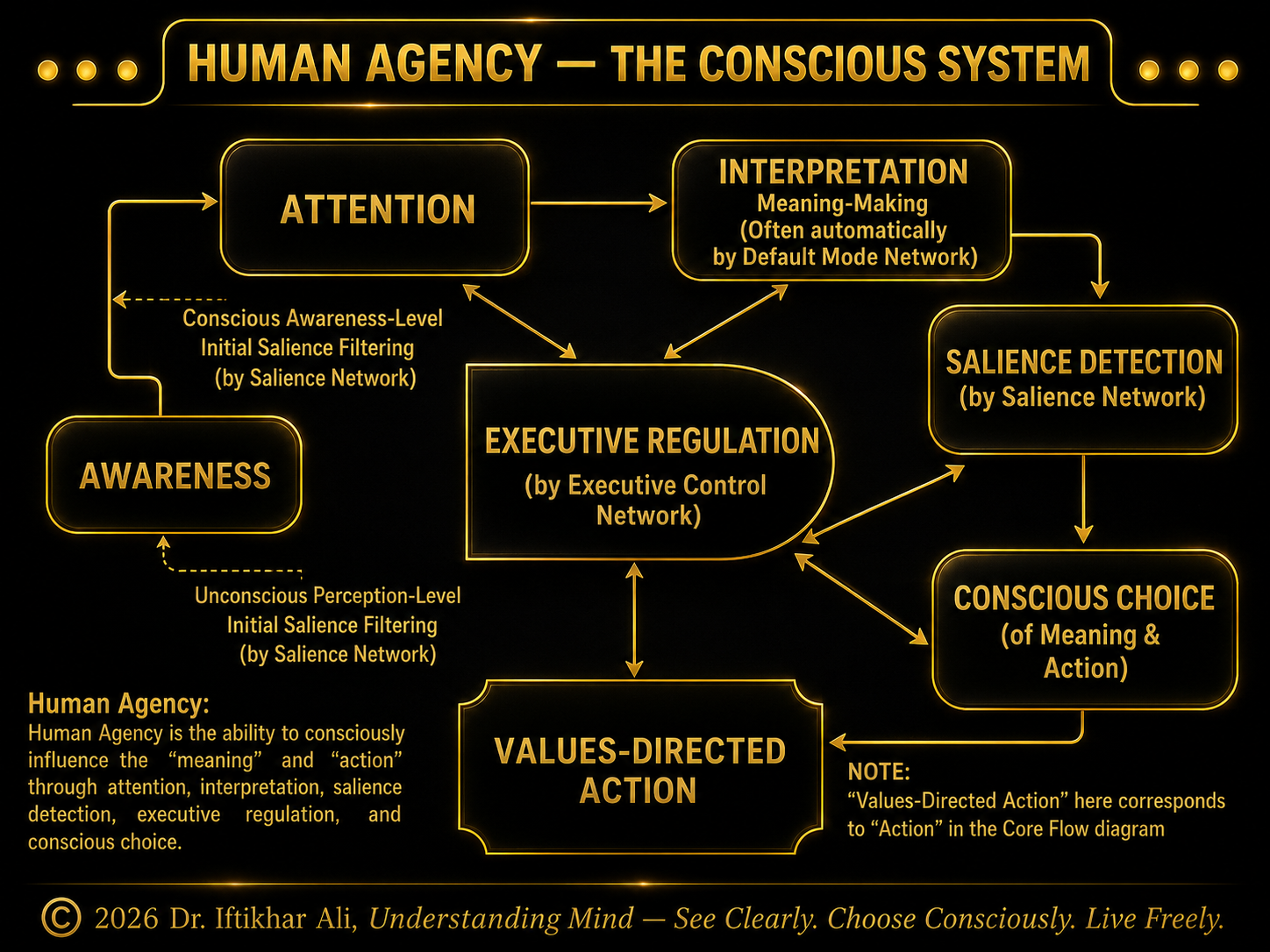
The answer is more specific, and more encouraging, than most people expect. Before you’re even aware that something has happened, an unconscious filter has already assessed it and flagged it as significant enough to notice at all — this is what brings a thing into Awareness in the first place, still below the threshold of conscious thought. From Awareness, a second filter, this one operating closer to consciousness, shapes exactly what Attention ends up settling on. Attention feeds Interpretation — the mind’s meaning-making, often automatic, often finished before you would even call it “thinking” — which in turn feeds Salience Detection, a further, ongoing assessment of how much this genuinely matters, right now, compared to everything else competing for the same limited attention.
At Conscious Choice, whatever agency was exercised earlier — everything attended to, interpreted, and judged for significance at the stages before — converges into one final, decisive act of its own. Conscious Choice is not one single act, but two, bound tightly together: choosing what something means, and choosing what to do about it. A person can take the meaning the automatic mind has already proposed and simply accept it — or pause, question it, and consciously revise it before acting on it at all. And only once that meaning has genuinely been owned, not merely inherited, does the second half of Conscious Choice occur: selecting the action that will actually follow, deliberately, rather than simply letting whatever feeling is loudest in that moment decide it instead.
Running through every one of these stages — not issuing orders from above, but in constant, two-way conversation with each — is Executive Regulation: the capacity that can question a snap interpretation, override a false alarm, or hold a choice open one moment longer than the automatic system alone would ever have allowed. What emerges, when this whole architecture is genuinely engaged, is Values-Directed Action — the same place the Automatic System’s own “Action” would have landed regardless, except now it has been examined, owned, and chosen, rather than merely produced. This is the entire difference between a life that happens to you and a life you actually live.