
The Feeling Equation: Why We Often Feel More Than What Is Happening
Have you ever wondered why a particular feeling can stay with you for hours—or even for days—when nothing dramatic is happening around you?
You may wake up feeling uneasy, inadequate, discouraged, or strangely comfortable, even when there is no obvious reason for it. We often say, “I just feel this way.” But what if that feeling is not simply an emotion caused by something happening ‘right now’?
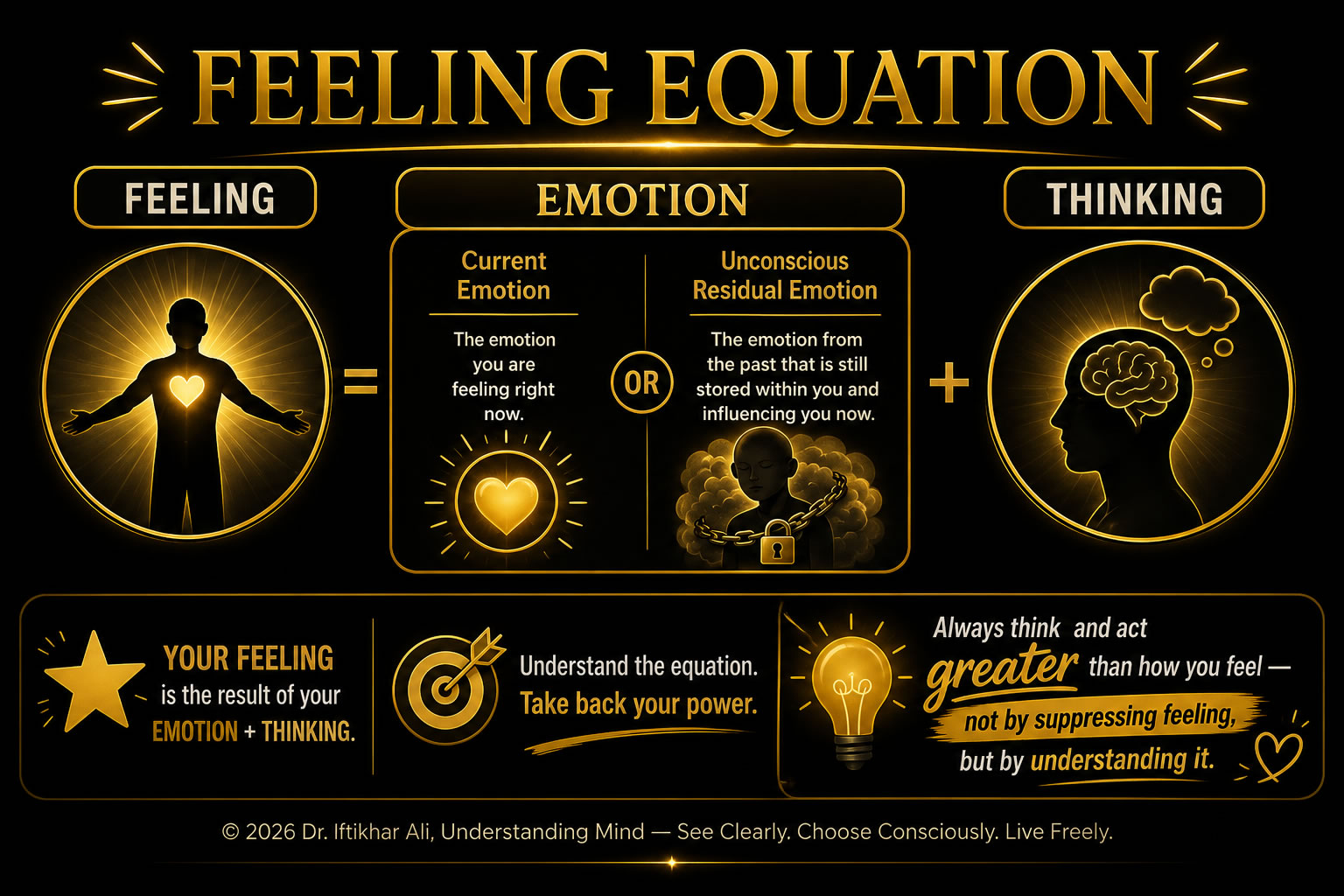
This question lies at the heart of the ‘Feeling Equation’ presented in *Understanding Mind*:
**Feeling = Emotion (Current OR Residual Emotion) + Thinking**
The equation offers a simple way to understand something surprisingly complex: ‘a feeling is more than an emotion.’ It emerges from the interaction between an emotional state and the mind’s ongoing thinking and interpretation.
Emotion Is Not the Whole Feeling
An ‘emotion’ can be relatively immediate. Something happens, the brain and body respond, and we experience an emotional reaction.
But the emotion contributing to a feeling does not necessarily have to come from the present moment. It may be a ‘Current Emotion’—the emotion you are experiencing right now. Or it may be an ‘Unconscious Residual Emotion’—an emotional residue from the past that remains stored in the system and continues to influence present experience.
The distinction matters.
You may be sitting quietly in your office, with nothing particularly threatening happening, yet still experience uneasiness. The immediate environment may not explain the feeling because part of its emotional component may be residual rather than current.
And then there is the second part of the equation: ‘Thinking.’
Our minds continuously interpret, evaluate, remember, anticipate, compare and construct meaning. This ongoing mental activity interacts with emotion and gives the experience its particular psychological quality — a story, a narrative, a belief.
That is why the same emotional state can produce very different feelings in different circumstances — or in different people.
Feelings Are the Emotional Weather of Life
The most intriguing implication of the equation is that ‘feelings need not have an obvious trigger’.
Unlike an acute emotional response that rises around a particular event, a feeling can become an almost continuous background state — the emotional “weather” of our lives.
It can quietly influence how we perceive the world, interpret what happens, and approach or avoid action.
Consider the feeling of “familiar.” Nothing dramatic is happening. There may be no fear, anger, grief, or anxiety. Yet there is a persistent sense:
This is known.
This is manageable.
This is safe.
This is me.
Because this feeling is so familiar and continuous, we may stop recognizing it as a feeling altogether.
‘We simply experience it as reality.’
And that is where the equation becomes particularly important.
The Feeling Behind the Comfort Zone
The ‘comfort zone’ is often misunderstood as something maintained by obvious fear. But the deeper mechanism can be much quieter.
A person may repeatedly avoid a new opportunity not because they experience an intense emotional crisis every time they consider it, but because the familiar way of living carries a persistent feeling of safety, predictability, and identity.
The feeling says, “This is how things are.”
The thinking then supplies reasons to support it:
“I’m not ready.”
“This isn’t for someone like me.”
“Perhaps I’ll do it later.”
“Things are fine as they are.”
The person may therefore experience the comfort zone not as a psychological construction, but simply as ‘reality’.
That is the trap.
Understanding the Equation Gives Us Choice
The purpose of the Feeling Equation is not to tell us to suppress feelings. Quite the opposite. It invites us to ‘understand what is producing them’.
If a feeling is influenced by current emotion, residual emotion, and ongoing thinking, then the feeling itself does not have to become the unquestioned authority over our behaviour.
We can notice it. We can examine it. We can understand it. And then we can choose what to do.
That is why the central message accompanying the model is:
“Always think and act greater than how you feel—not by suppressing feeling, but by understanding it.”
A feeling is real as an experience. But ‘a feeling is not necessarily a command’.
Understanding the Feeling Equation can therefore become a powerful step toward taking back something that matters deeply:
‘The power to choose how we live, even when our feelings are telling us otherwise.’