
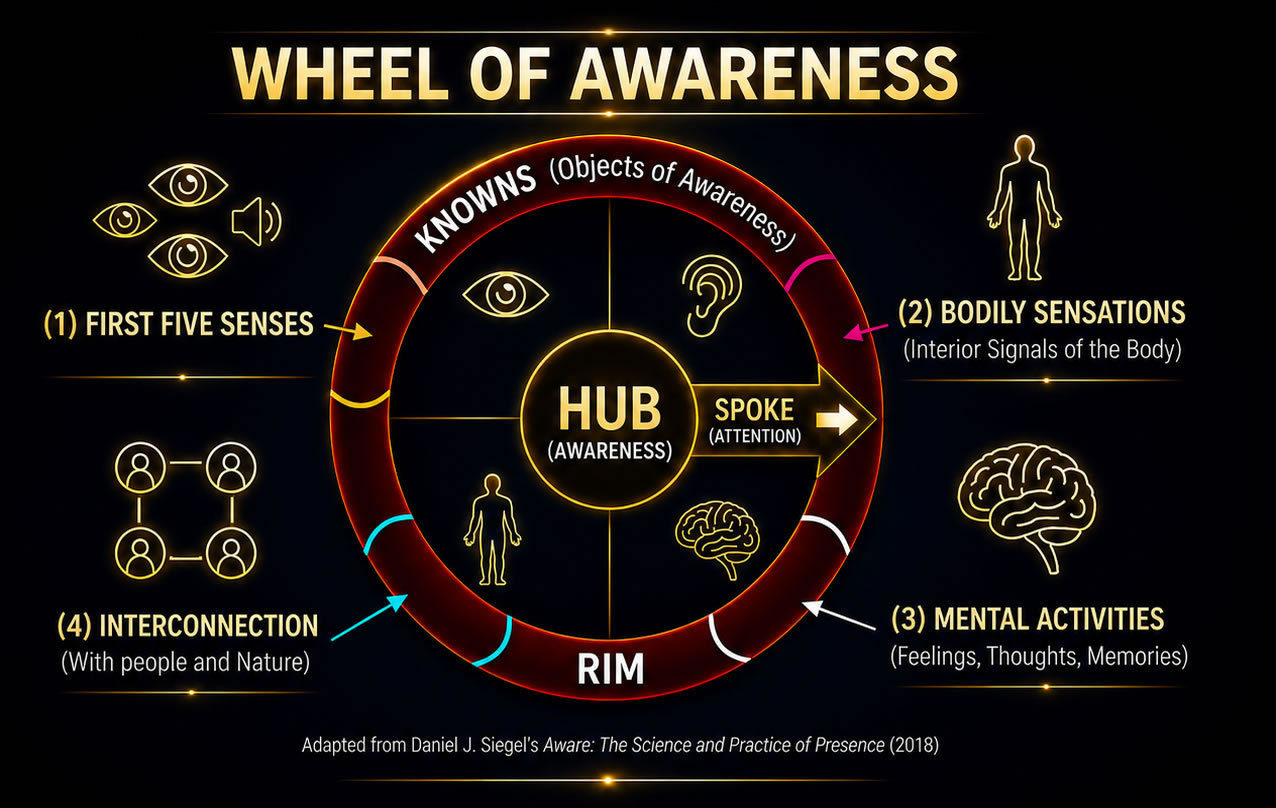
The Wheel of Awareness: From Being Caught in Experience to Becoming the Witness
What if the thoughts, feelings, sensations, and memories that fill our minds are not who we are, but simply things we can become aware of?
This is one of the most useful insights offered by psychiatrist and interpersonal neurobiologist Daniel J. Siegel through his Wheel of Awareness. In Understanding Mind, I explore this model alongside the Structure of Human Self (SHS) and the concept of the Real “I”, because the two frameworks converge on a remarkably similar distinction: there is a part of our experience that is known, and there is a capacity within us that knows.
The Hub, the Spoke and the Rim
Siegel’s Wheel provides a simple visual way to understand awareness.
At the centre is the Hub—the faculty of knowing or awareness itself. Around it is the Rim, containing everything we can become aware of: sensory experiences, bodily sensations, thoughts, feelings, memories, and our sense of connection with other people and the world.
The Spoke represents Attention—the capacity to deliberately direct awareness toward one particular aspect of experience.
In simple terms:
Awareness notices.
Attention selects.
Agency enters.
This distinction is crucial. Awareness provides the open field in which experience occurs; attention allows us to deliberately select what we engage with. When attention is consciously directed rather than automatically captured, we have greater opportunity to exercise choice.
When the Mind Loses the Hub
One of the most important applications of the Wheel is understanding fusion.
Imagine that an angry thought appears: “They have treated me unfairly.”
Normally, the thought is something we can notice. But when attention is automatically captured by it, we may cease to experience it as a thought we are having. It becomes our reality.
The same can happen with fear, sadness, self-criticism or an anxious prediction.
The Wheel describes this visually: awareness is pulled from the Hub into a particular object on the Rim. Instead of observing the thought or feeling, we become absorbed in it.
This is what the book calls fusion—when the Knowns begin to occupy the place of the Knower.
Defusion: Returning to the Hub
The opposite movement is defusion.
Defusion does not mean suppressing a thought, fighting a feeling, or forcing the mind to become empty. It means creating enough distance to recognize:
“This is a thought.”
“This is a feeling.”
“This is a bodily sensation.”
“This is a memory.”
The experience remains on the Rim, but we are no longer completely absorbed in it. Attention can return to the Hub—the witnessing centre from which experience can be observed rather than automatically obeyed.
Four Dimensions of What We Can Know
Siegel’s fuller Wheel divides the Rim into four broad areas.
The first is the external senses—what we see, hear, smell, taste and touch.
The second is bodily sensations—the signals coming from within the body.
The third is mental activities—thoughts, feelings and memories. This is where much of our everyday psychological activity occurs, and where automatic narrative and fusion can dominate attention.
The fourth is interconnection—our direct sense of relationship with other people and with nature.
The significance is profound: our attention can move among all these dimensions, while the Hub remains the capacity that knows them.
Why the Wheel Matters
Much of our difficulty in life comes not simply from what we experience, but from where our attention goes and how completely we become identified with what it encounters.
The Wheel of Awareness offers a practical reminder:
You can have a thought without being the thought.
You can experience an emotion without becoming the emotion.
You can notice a memory without living inside the past.
The practice, therefore, is not to eliminate experience but to develop the capacity to return the Spoke of Attention to the Hub and then deliberately direct it toward what genuinely matters.
That movement—from automatic capture to conscious direction—is at the heart of awareness, agency, and ultimately, living more freely.